Company Observatory / Consumer value chains
ITOCHU Corporation
伊藤忠商事
Capability we observeRedesigning how daily necessities reach people, starting from demand
We observe the ability to redesign how daily necessities reach people, starting from demand. Trading scale and transaction volume are not treated as social value by themselves.
Observation premises and assessment definitionsUnder observation ≠ selection approval
The next review date is an editorial target, not a company announcement date or an automatic update. We record the content and date of completed reviews.
Initial baseline: 2026-10-13
Sources included: 21 (last checked 2026-11-13)
Comparison: two endpoints, FY ended March 2016 and FY ended March 2026
Read the consolidated disclosures for the years ended March 2016 and March 2026 as evidence of economic resources supporting the capability. These are ten-year endpoints, not an annual time series. Comparison conditions differ by metric because gross/net revenue presentation and lease classifications changed.
How to read the badges
- Evidence status
- Confirmed, partially confirmed, unconfirmed, and counterevidence describe the evidence for each claim. Confidence describes certainty in that assessment.
- Data notes
- A proxy is not a direct measurement of the capability. Different series have differing accounting standards or scope and cannot be used for a simple growth comparison.
- Observation judgment
- Unclear means there is insufficient evidence to say the capability strengthened or weakened. It does not mean there was no change.
01
Capabilities we observe
The subject is not company performance, but the capability and whom it enables.
Redesigning how daily necessities reach people, starting from demand
We observe the capability to connect overseas sourcing, manufacturing, processing, wholesale, logistics and retail, and return demand to products and supply.
Formation and contributions from Japan and overseas
Concrete example
The concrete example is fresh eggs sold at FamilyMart. The Food Company group covers imported feed corn, feed manufacturing, poultry raising, egg production and processing, and refrigerated delivery.
Reason for this assessment
Company materials identify the stages and responsible group entities.
Unknowns
Replicability and outcomes beyond eggs.
What we check next
Add at least two externally verifiable examples beyond eggs.
Formation
The capability layers FamilyMart's pre-existing capabilities and domestic and overseas production, wholesale, logistics and franchise operations onto merchant practice dating to ITOCHU's 1858 linen trade. It is not an ITOCHU-only achievement.
Reason for this assessment
Formation actors are identifiable, but their incremental contributions cannot be separated.
Unknowns
Contribution shares of FamilyMart, ITOCHU, suppliers, logistics providers and franchisees.
What we check next
Reconcile actor roles and outcomes with partner evidence.
ITOCHU History / Corporate History / Retail — Fresh Egg Value Chain
Contribution from Japan
Japanese customer-led trading, food wholesale and logistics, and FamilyMart's stores and POS contributed to formation. FamilyMart's earlier capabilities are not reassigned to ITOCHU.
Reason for this assessment
Japanese formation is documented, while the boundary with FamilyMart's pre-existing capability remains.
Unknowns
Japan's incremental causal contribution.
What we check next
Separate additional contributions before and after FamilyMart participation.
Overseas and external contribution
Overseas producers, raw-material suppliers, local businesses and logistics providers jointly form supply and operations. Overseas actors are not treated merely as sources of goods.
Reason for this assessment
The overseas supply chain is visible, but actor-level contributions are incomplete.
Unknowns
Contributions of overseas actors to specifications and operations.
What we check next
Add evidence from producers, logistics providers and local businesses.
Food Company / Structures and Systems - Supply Chain Management
Relationship with the world
Connected processes can support continuity of daily necessities, but ITOCHU-specific reductions in stockouts and waste and consumer benefits remain unverified.
Reason for this assessment
The supply mechanism is documented, while issuer-specific outcomes are not.
Unknowns
ITOCHU-specific effects on stockouts, waste, prices and choice.
What we check next
Seek independent stockout, waste, price and benefit metrics.
Retail — Fresh Egg Value Chain / RFID Demonstration Report for Supply Chain Efficiency / Food Loss Reduction Initiatives
Inheritance and renewal
ITOCHU updates the demand-led system through digital tools, audits and product development. We also observe food waste, human rights, forests and value sharing with franchisees and suppliers.
Reason for this assessment
Renewal initiatives are disclosed, but causal evidence for burden reduction is incomplete.
Unknowns
Results on food waste, human rights, forests and value sharing.
What we check next
Track burdens and improvements annually on consistent definitions.
Structures and Systems - Supply Chain Management / Recommendation to FamilyMart Co., Ltd. / Food Loss Reduction Initiatives
Conditions for substitution
Other trading companies, food wholesalers, manufacturers, logistics providers and retailers are alternatives. The cost and time to switch ownership ties, private-label specifications, demand data and logistics are unverified.
Reason for this assessment
Alternatives exist, while comparative switching evidence is absent.
Unknowns
Use-case-specific switching cost, time and supply effect.
What we check next
Compare switching conditions with competing supply-chain arrangements.
Survey on Transactions Between Convenience Store Headquarters and Franchisees
Indicators of the capability
- Stockouts, prices and consumer outcomesNot disclosed
- Food wasteCompany-reported
- Supplier survey and audit coverageCompany-reported
- Value and burden sharing with franchiseesNot disclosed
- Conditions for switching to alternativesNot disclosed
These indicators track maintenance and renewal of the capability, separately from profit and share price.
02
Capability observations
At dated checkpoints, we record confirmed values, limitations, and the next check.
Recorded five initial indicators, separating FamilyMart food-waste data and ITOCHU survey activity from verified benefits and remedies for consumers and franchisees. This is not a period-on-period change. The latest verified earnings announcement is November 4, 2026 for the first half of the year ending March 2027. December 14 is an internal follow-up target, not a company release date or a promise of automatic execution.
Stockouts, prices and consumer outcomes
UnconfirmedObservation basis: Undated ITOCHU Retail page accessed 2026-11-13
ITOCHU describes a FamilyMart egg chain connecting feed-corn imports, feed manufacturing, poultry raising, egg production and processing, and refrigerated delivery. This documents a mechanism, rather than measured improvements in stockouts, prices or safety.
- Limits of this value
- The company mechanism description does not establish consumer benefits with a measurement period, denominator or comparator. Do not generalize eggs to all products or global outcomes. Alternative supply-chain outcomes and additional franchisee work and discount burdens remain unverified; absence of evidence does not establish absence of benefit.
- What we check next
- Seek stockout, price, safety and choice outcomes with a common product, geography, period, denominator and comparator; reconcile partner and consumer evidence. Track franchisee burdens and alternative arrangements separately.
Food waste
Partially confirmedObservation basis: FamilyMart FY2025 (2025-03-01 to 2026-02-28)
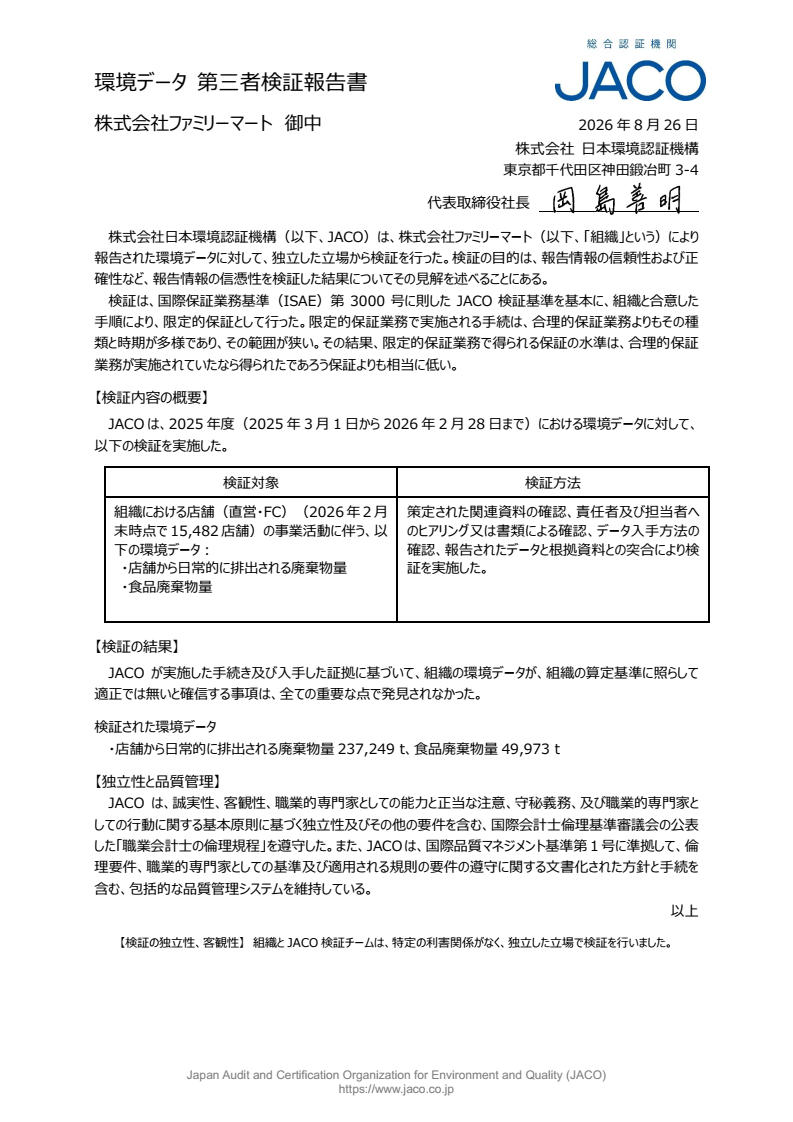
FamilyMart reports 49,973 tonnes of food waste for FY2025, March 1, 2025 to February 28, 2026. JACO limited assurance dated August 26, 2026 covers organization stores, direct-operated and franchise, numbering 15,482 at February 2026 end. This is an initial waste-generation baseline, not a reduction or an ITOCHU-specific outcome.
- Limits of this value
- Limited assurance addresses reported waste data, not causal effects or ITOCHU incremental contributions. Food waste is not established as edible-only food loss. The 2030 and 2050 reduction targets against 2018 are not actual results. Sales or volume intensity, within-year store changes, franchisee burdens, household waste displacement and global coverage remain unverified.
- What we check next
- Track next-year absolute waste and sales or volume intensity on consistent definitions. Check the 2018 baseline, edible fractions, franchisee costs and work, and household displacement; distinguish waste prevention from recycling.
Food Loss Reduction Initiatives / Limited assurance report on FamilyMart FY2025 environmental data / FamilyMart ESG data
Supplier survey and audit coverage
Partially confirmedObservation basis: FY2025 issuer-labelled sustainability surveys; accessed 2026-11-13
ITOCHU reports sustainability surveys of 324 suppliers, including 106 in Food, in issuer-labelled FY2025. It reports 59% three-year coverage of eligible partners, 39 reconfirmations and no corrective-action requests that year. This baseline records survey coverage, not worker remedy or an audit rate for all suppliers.
- Limits of this value
- ITOCHU reports 324 suppliers surveyed in issuer-labelled FY2025, including 106 in Food, and 59% three-year coverage of partners meeting its survey criteria. This is not an audit rate for all suppliers or workers. Its 39 reconfirmations and no corrective-action requests that year are issuer-reported survey results, not independent verification of worker remedy. The 391 overseas food-safety surveys, 37 China regular/follow-up audits and FamilyMart third-party audits at 20 factories have distinct populations and purposes and are not added together.
- What we check next
- Check survey eligibility and denominators, distinguish surveys from third-party audits, and seek worker-side assessments and remedy outcomes following reconfirmations.
Value and burden sharing with franchisees
UnconfirmedObservation basis: 2016 subcontractor case / 2020 franchise survey and response / contract page accessed 2026-11-13
Current FamilyMart recruitment material discloses headquarters fees and cost responsibilities by contract type. The reviewed evidence does not establish a consistent realized-outcome series for franchisee net income, owner labor and waste or markdown burdens.
- Limits of this value
- The recruitment page discloses fees and cost responsibilities by contract type, but the reviewed evidence does not establish realized franchisee net income, working hours and waste/markdown burdens for a common population. The 2016 recommendation concerned the then FamilyMart legal entity reducing payments to 20 food-manufacturing subcontractors; it does not measure franchisee sharing or establish a current violation by ITOCHU itself. The 2020 industry survey and issuer self-inspection do not prove current improvement outcomes.
- What we check next
- Check longitudinal franchisee earnings, owner hours and waste/markdown burdens by contract type, alongside independent verification of improvements.
Recommendation to FamilyMart Co., Ltd. / Survey on Transactions Between Convenience Store Headquarters and Franchisees / Franchise contract types and opening process / Self-inspection and improvements in response to JFTC franchise survey
Conditions for switching to alternatives
UnconfirmedObservation basis: 2020 industry survey / contract page accessed 2026-11-13
Current FamilyMart recruitment material describes ten-year contracts, while the 2020 JFTC industry survey addresses termination and non-compete terms. Individual franchise terms and the cost or time to replace ITOCHU sourcing and logistics networks are separate populations; a common switching indicator remains unconfirmed.
- Limits of this value
- The 2020 JFTC survey provides historical industry context on terms, exit fees and non-compete obligations. The current FamilyMart recruitment page describes ten-year contracts, but does not establish the costs or time to replace ITOCHU supply networks or each franchisee's exit/non-compete terms. Anonymous chain statistics are not attributed to FamilyMart.
- What we check next
- Check current contract disclosures, exit costs, non-compete terms and conversion examples; separately investigate cost and time to replace product and logistics networks.
Survey on Transactions Between Convenience Store Headquarters and Franchisees / Franchise contract types and opening process
03
Reach and surrounding context
The scope is the relationship that returns demand from consumer touchpoints such as FamilyMart to raw-material sourcing, manufacturing, processing, wholesale, logistics and retail. It excludes the resource portfolio as a whole, one-off intermediation and capabilities independently formed by partners.
The current capability combines Japanese merchant practice rooted in the Ohmi tradition, stores, POS and logistics developed by FamilyMart before ITOCHU's participation, and the operations of overseas producers, logistics providers and franchisees.
ITOCHU History / Corporate History / Retail — Fresh Egg Value Chain
We observe not only continuity of supply but also food waste, burdens borne by suppliers and franchisees, and transaction fairness. The JFTC's 2016 recommendation was addressed to FamilyMart Co., Ltd., not to ITOCHU Corporation itself.
Food Loss Reduction Initiatives / Recommendation to FamilyMart Co., Ltd. / Survey on Transactions Between Convenience Store Headquarters and Franchisees
04
Economic base supporting the capability
We compare FY ended March 2016 and FY ended March 2026 as evidence of the capacity to maintain and renew the capability.
This compares two endpoints, not an annual time series.
Revenue
Company disclosureQualified comparison
The reported revenue values are retained. IFRS 15 adoption in the year ended March 2019 changed some transactions from net to gross presentation, increasing revenue and cost by JPY5,090.724bn each that year. A restatement of FY2016 to the same basis has not been verified. A simple growth rate or CAGR is therefore withheld.
Consolidated Financial Results for the Fiscal Year Ended March 31, 2016 / Consolidated Financial Results for the Fiscal Year Ended March 31, 2026 / Financial Section 2019
Trading income (company-defined)
Company disclosureCAGR 12%
Trading income is company-defined: gross trading profit plus SG&A expenses plus provision for doubtful accounts, with expenses signed negative. It is not equivalent to a conventional operating company's IFRS operating profit. Both endpoints use this definition, but consolidation scope and lease accounting changed.
Consolidated Financial Results for the Fiscal Year Ended March 31, 2016 / Consolidated Financial Results for the Fiscal Year Ended March 31, 2026
Trading income margin
Market Flow calculationQualified comparison
Market Flow calculation: company-defined trading income divided by revenue. The respective annual calculations are 4.45% and 4.74%. Changes between net and gross revenue presentation prevent a like-for-like conclusion about margin improvement.
Consolidated Financial Results for the Fiscal Year Ended March 31, 2016 / Consolidated Financial Results for the Fiscal Year Ended March 31, 2026 / Financial Section 2019
Operating cash flow
Company disclosureQualified comparison
Net cash provided by operating activities in the consolidated cash flow statements. IFRS 16 lease accounting changed between the endpoints; FY2026 lease liability repayments of JPY259.227bn are financing cash flow. The series is not adjusted for classification or consolidation changes, so CAGR is withheld.
Consolidated Financial Results for the Fiscal Year Ended March 31, 2016 / Financial Information Report 2026
Standard FCF
Market Flow calculationQualified comparison
Market Flow calculation: operating cash flow less gross cash purchases of property, plant, equipment and intangible assets. FY2016 uses audited gross payments of JPY95.866bn, correcting FCF to JPY323.538bn; FY2026 deducts JPY284.991bn, giving JPY846.846bn. Disposal proceeds are excluded. Lease principal repayments are not deducted. This differs from ITOCHU's FCF, which sums operating and investing cash flows. Lease accounting and consolidation differences remain, so CAGR is withheld.
Return on equity (ROE)
Company disclosureReported consolidated IFRS figures for the years ended March 2016 and March 2026. ITOCHU may label the latter FY2025. Changes in consolidation scope are included; the figures do not isolate outcomes from the consumer value chain capability.
Consolidated Financial Results for the Fiscal Year Ended March 31, 2016 / Financial Information Report 2026
05
Mechanisms that sustain the capability
Returning demand to the supply chain
The system returns retail demand to product design, sourcing, processing, inventory and delivery. We test it through stockouts, waste, prices and choice rather than scale.
Observation KPIs
Stockouts, prices and consumer outcomes · Food waste
Orchestration across companies
ITOCHU connects producers, manufacturers, wholesalers, logistics and retailers through ownership, contracts and operations. Fair value sharing and substitutability remain part of the test.
Observation KPIs
Supplier survey and audit coverage · Value and burden sharing with franchisees · Conditions for switching to alternatives
Structures and Systems - Supply Chain Management / Survey on Transactions Between Convenience Store Headquarters and Franchisees
Initial capability KPI values and their verification limits are recorded under Capability observations.
06
Conditions for revisiting the current account
These are conditions for reinvestigating the business hypothesis, not bearish signals for the share price.
Assessment horizon: annual and product-cycle review
Current premise
Connecting demand information with supply operations reduces stockouts and waste and supports consumer choice.
Evidence that would trigger reconsideration
We will revise the account if independent evidence cannot identify ITOCHU-specific improvement or alternative arrangements produce equivalent outcomes.
Current observation
The egg-chain connection is documented, but incremental effects on stockouts, waste, prices and consumer outcomes are not.
Observation KPIs
Stockouts, prices and consumer outcomes · Food waste
Retail — Fresh Egg Value Chain / Food Loss Reduction Initiatives
Assessment horizon: annual and regulatory review
Current premise
The benefits and burdens of orchestrating the chain can be shared fairly with suppliers, logistics providers and franchisees.
Evidence that would trigger reconsideration
Repeated unfair deductions or burden shifting without verified remediation would weaken the inheritance assessment.
Current observation
The JFTC recommended corrective action to FamilyMart Co., Ltd. in 2016. It was not an enforcement action against ITOCHU Corporation, but remains counterevidence for the group capability.
Observation KPIs
Value and burden sharing with franchisees · Supplier survey and audit coverage
Recommendation to FamilyMart Co., Ltd. / Survey on Transactions Between Convenience Store Headquarters and Franchisees / Structures and Systems - Supply Chain Management
Assessment horizon: annual and contract-cycle review
Current premise
The connected relationships create value beyond an ordinary change of supplier.
Evidence that would trigger reconsideration
If another combination of trading companies, wholesalers, logistics providers and retailers can replace it cheaply with equal outcomes, we will revise the specificity claim.
Current observation
Alternatives exist, while the time and cost to switch contracts, private-label specifications, demand data and logistics remain unverified.
Observation KPIs
Conditions for switching to alternatives
Survey on Transactions Between Convenience Store Headquarters and Franchisees
07
Major events
JFTC recommendation to FamilyMart Co., Ltd.
- Confirmed facts
- On August 25, 2016, the Japan Fair Trade Commission issued a recommendation to FamilyMart Co., Ltd. over reductions in subcontract proceeds. It was not an enforcement action against ITOCHU Corporation itself.
- Company response
- We distinguish the legal entity subject to the recommendation and use the event as counterevidence when observing group-level transaction and value-sharing practices.
- Remaining risk
- We continue to examine post-remediation terms, burdens on franchisees and contractors, and recurrence.
Study of convenience-store head-office and franchisee transactions
- Confirmed facts
- In 2020 the JFTC conducted an industry-wide study of transactions between convenience-store headquarters and franchisees. It does not establish an ITOCHU-specific violation.
- Company response
- The study informs observation of purchasing, waste and operating-hour burdens.
- Remaining risk
- FamilyMart-specific results, and the incremental role attributable to ITOCHU, remain unverified.
Survey on Transactions Between Convenience Store Headquarters and Franchisees
Limited assurance of FamilyMart food-waste data
- Confirmed facts
- The JACO limited assurance report dated August 26, 2026 covers 49,973 tonnes of food waste and other data for direct-operated and franchise stores from March 1, 2025 to February 28, 2026. This is the report date, not a verified website publication date.
- Company response
- FamilyMart publishes ESG data and the assurance report. Actual results and their scope are separated from food-loss reduction targets.
- Remaining risk
- Limited assurance over data does not establish causal effects of initiatives, ITOCHU incremental contribution, franchisee burdens or waste shifted to households.
Limited assurance report on FamilyMart FY2025 environmental data / FamilyMart ESG data / Food Loss Reduction Initiatives
08
Primary sources and definitions
- Consolidated Financial Results for the Fiscal Year Ended March 31, 2016ITOCHU Corporation · Company material · Accessed 2026-11-13
- Consolidated Financial Results for the Fiscal Year Ended March 31, 2026ITOCHU Corporation · Company material · Accessed 2026-11-13
- Financial Information Report 2026ITOCHU Corporation · Company material · Accessed 2026-11-13
- ITOCHU HistoryITOCHU Corporation · Company material · Accessed 2026-10-13
- Food CompanyITOCHU Corporation · Company material · Accessed 2026-10-13
- Retail — Fresh Egg Value ChainITOCHU Corporation · Company material · Accessed 2026-11-13
- Corporate HistoryFamilyMart Co., Ltd. · Company material · Accessed 2026-10-13
- Structures and Systems - Supply Chain ManagementITOCHU Corporation · Company material · Accessed 2026-11-13
- Food Loss Reduction InitiativesFamilyMart Co., Ltd. · Company material · Accessed 2026-11-13
- RFID Demonstration Report for Supply Chain EfficiencyMinistry of Economy, Trade and Industry · Government · Accessed 2026-10-13
- Recommendation to FamilyMart Co., Ltd.Japan Fair Trade Commission · Regulator · Accessed 2026-11-13
- Survey on Transactions Between Convenience Store Headquarters and FranchiseesJapan Fair Trade Commission · Regulator · Accessed 2026-11-13
- Financial Section 2016ITOCHU Corporation · Company material · Accessed 2026-11-13
- Financial Section 2019ITOCHU Corporation · Company material · Accessed 2026-11-13
- Consolidated Financial Results for the First Half of the Fiscal Year Ending March 31, 2027ITOCHU Corporation · Company material · Accessed 2026-11-13
- IR CalendarITOCHU Corporation · Company material · Accessed 2026-11-13
- IR News 2026ITOCHU Corporation · Company material · Accessed 2026-11-13
- Franchise contract types and opening processFamilyMart Co., Ltd. · Company material · Accessed 2026-11-13
- Self-inspection and improvements in response to JFTC franchise surveyFamilyMart Co., Ltd. · Company material · Accessed 2026-11-13
- FamilyMart ESG dataFamilyMart Co., Ltd. · Company material · Accessed 2026-11-13
- Limited assurance report on FamilyMart FY2025 environmental dataJapan Audit and Certification Organization (JACO) · Independent research · Accessed 2026-11-13
Correction history
- 2026-11-13 Corrected FY2016 standard FCF from JPY340.649bn to JPY323.538bn using audited gross cash purchases of JPY95.866bn. Added gross/net revenue and lease-classification limitations and withdrew revenue, operating-CF and standard-FCF CAGR. Corrected the food-waste event to the verified assurance-report date of August 26, 2026, separately from unknown website publication timing.
Financial Section 2016 / Financial Section 2019 / Financial Information Report 2026 / Limited assurance report on FamilyMart FY2025 environmental data